[Vilnius(Lithuania)= Lim Jeong-yeo, Edaily Reporter] Gitanas Nauseda, the President of Lithuania, on Wednesday (local time) promised to step up his offer for life sciences R&D incentives, so that five years down the road this sector will double its contribution to the national gross domestic product (GDP). Nauseda, serving his second term after being reelected in May 2024, pledged in his opening remarks at Life Sciences Baltics 2025 that, “We are on the right track. And the offer will only get better.”
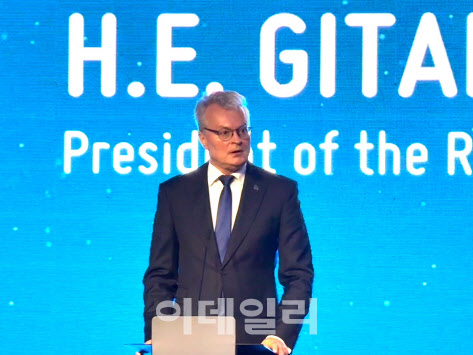 | | Gitanas Nauseda, President of LIthuania(Photo=Lim Jeong-yeo, Edaily) |
|
Nauseda said, “Lithuania’s life sciences sector has great economic value. It creates nearly three percent of national GDP, and our goal is to double this contribution by 2030. To achieve this, we will have to focus more on scaling up expertise and value-added work in biomanufacturing and personalized medicine. Right now we are on the right track. Lithuania ranks third among OECD countries in biotech R&D spending intensity. Around 86 percent of our pharmaceuticals and healthcare products are exported to over 100 countries. We produce world-class STEM (Science, Technology, Engineering, Mathematics) graduates for industry and research.”
What’s more important, he added, is that the country feels the responsibility to improve and push forward.
Participants flock from across Europe
Nauseda said, “The Life Sciences Baltics event reflects Lithuania’s deep and long-standing connection with life sciences. Ever since the early 19th century, when Professor Andrius Sniadeckis laid the foundations for natural sciences, our universities and laboratories have been centers of scientific excellence. Most recently, Lithuanian scientists -- among them the distinguished Professor Virginijus Siksnys -- have demonstrated our ability to make a global impact.”
He continued, “To gain even more momentum, we are also building an advanced network of regional and global partnerships. Since 2018, when Lithuania became an associate member of CERN (the European Organization for Nuclear Research), we have been investigating nuclear medicine capabilities, including the use of modern cyclotrons in clinics. Since 2019, Lithuania, as a full member of the European Molecular Biology Laboratory, has been an active partner in European research infrastructures.”
“Our new, modern facilities -- life science centers at universities, hospital research units, and private sector laboratories -- make new discoveries possible. They enable translational research from bench to bedside and contribute to more effective and efficient patient-centric healthcare,” Nauseda said.
Life Sciences Baltics is a biennial event that takes place in Vilnius, Lithuania. It was temporarily halted during the COVID-19 pandemic and resumed in 2023. This year’s event is the seventh to be held.
Main topics this year include DNA and data storage, personalized medicine, cell and gene therapy, radioligand therapy, the impact of artificial intelligence on healthcare, and more. On this day, Lithuanian startup Delta Biosciences signed a memorandum of understanding (MoU) with the U.K.’s LinkGevity on safety checks for anti-necrotic stability testing in space.
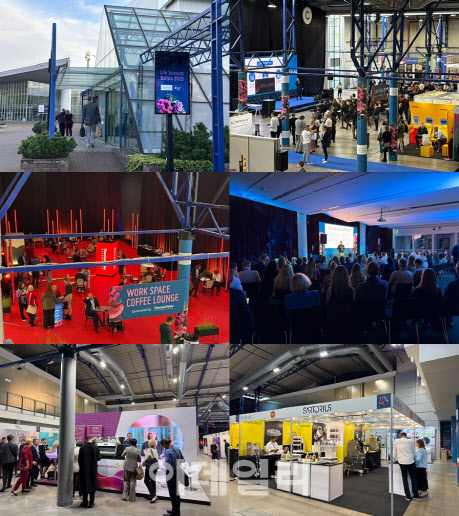 | | Life Sciences Baltics 2025(Photo=Lim Jeong-yeo) |
|












 랭킹뉴스